

How to Recover Saved Passwords in Mozilla Firefox


In this article, you’ll learn where Firefox browser stores your passwords, how they are protected, and how you can easily recover them.
Firefox Password Secrets
Firefox browser saves all your website login passwords at following location
[Windows Vista/7/8/10]
C:\Users\[user_name]\AppData\Roaming\Mozilla\Firefox\Profiles\[random name].default\

[Windows XP/2003]
C:\Documents and Settings\[user_name]\Application Data\Mozilla\Firefox\Profiles\[random name].default\
Older version of Firefox (before v32.0) used to store all website logins in a SQLite database file called ‘signons.sqlite’ in the above profile folder.
This database file has the table called “moz_logins” where each of the website login details are saved.
Here are some of the interesting fields stored in this table,
id - index of each website entry
hostname - main link of the website or ipaddress
formSubmitURL - login link of the website
usernameField - name of the username field in the website
encryptedUsername - encrypted username
passwordField - name of the password field in the website
encryptedPassword - encrypted password
encType - value 1 indicates encrypted
Here formSubmitURL, encryptedUsername and encryptedPassword refers to website login link, encrypted username and encrypted password respectively.
Firefox uses Triple DES and SHA1 algorithm to encrypt both username & password. Finally the resulting password is stored in above file using Base64 format.
Newer version of Firefox (after v32.0) stores all the website logins in JSON format file called ‘logins.json’
Here is the sample of one of the website entry from this file,
{
"id":1,
"hostname":"https://accounts.google.com",
"httpRealm":null,
"formSubmitURL":"https://accounts.google.com",
"usernameField":"user",
"passwordField":"pwd",
"encryptedUsername":"MDIEEPgBBBBABBBEwFAYIbaZIhvcNAwcEaAFsqdqBAiJyHK56O9cid==",
"encryptedPassword":"MDoEEPgBCCCCAAAAAAEwFCDIKoZIBAtABCG4rNAexni08zRm4Sraz/",
"guid":"{46cfe997-9043-40e8-8207-6d6cf222bcb4}",
"encType":1,
"timeCreated":1304064618760,
"timesUsed":25
},
Here formSubmitURL, encryptedUsername and encryptedPassword refers to website login link, encrypted username and encrypted password respectively.
Similar to older version, new Firefox also uses Triple DES and SHA1 algorithm to encrypt both username & password. After encryption, resulting password is stored in Base64 format in the above file.
Firefox Master Password
Firefox also allows you to set Master Password to prevent others from stealing your website passwords. If the master password is set then without it website passwords cannot be decrypted.
To make it further secure, Firefox encrypts master password using one way hash algorithm. That means it cannot be decrypted instantly and only way to recover it using brute-force method which may take years based on length and complexity of master password.
Firefox stores master password details in files called key4.db and cert9.db in the same profile folder as above. Older version used filenames called key3.db and cert8.db.
How to Recover Firefox Browser Passwords Automatically
Now you can easily recover all your forgotten passwords from Firefox browser without any technical knowledge.
With just one click, XenArmor Browser Password Recovery Pro can recover all your saved Firefox website passwords in seconds.
Follow these simple steps,
- Download & install the software from here
- Click on “Recover Passwords”
- Instantly see all your website passwords from Firefox browser
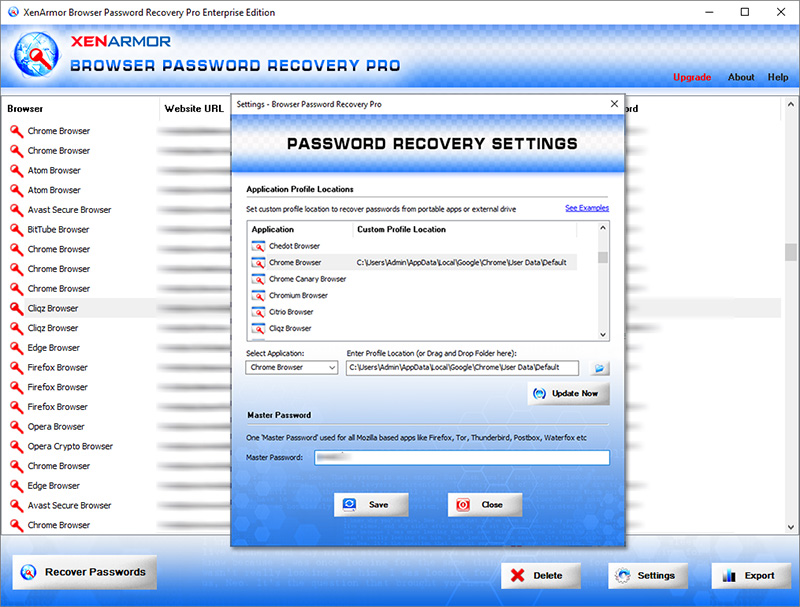
Here are the key features loved by users,
- Works across 140+ web browsers
- Recover all website passwords
- Also recover Form Autofill secrets (key, code, credit card etc)
- Extract from all profiles & custom locations
- Support command-line & automation
- Easily identify with multi-colored display
- Export secrets to PDF, HTML, CSV, JSON & more
👉 Free Download XenArmor Browser Password Recovery Pro
Recommended Posts

How to Switch from PIN to Password Login on Windows
November 29, 2025