

How to Recover Saved Passwords in Opera Browser


In this article, you’ll learn where Opera browser stores your passwords, how they are protected, and how you can easily recover them.
Opera Browser Password Secrets
Latest version of Opera browser stores all your website login passwords in the “Login Data” file at following location
[Windows Vista/7/8/10]
C:\Users\[user_name]\AppData\Roaming\Opera Software\Opera Stable\

[Windows XP/2003]
C:\Documents and Settings\[user_name]\Application Data\Opera Software\Opera Stable\
This “Login Data” file is stored in SQLite database format. It contains database table called “logins” where each website login details are stored.
Here are some of the interesting fields stored in this table,
origin_url - main link of the website
action_url - login link of the website
username_element - name of the username field in the website
username_value - username used for login
password_element - name of the password field in the website
password_value - password used for login (encrypted)
Here action_url, username_value and password_value refers to website login link, username and encrypted password respectively.
Opera browser encrypts the website password using Windows DPAPI (Data Protection API) functions. Please refer to next section to know how to decrypt these passwords.
Older versions of Opera browser used to store website logins in file called “wand.dat”.
Below are the file location for different versions of Opera browser
Opera v10.0 and later
----------------------

[Windows Vista/7/8/10]
C:\Users\[user_name]\AppData\Roaming\Opera\Opera\wand.dat

[Windows XP/2003]
C:\Documents and Settings\[user_name]\Application Data\Opera\Opera\wand.dat


Opera less than v10.0
----------------------

[Windows Vista/7/8/10]
C:\Users\[user_name]\AppData\Roaming\Opera\Opera\profile\wand.dat

[Windows XP/2003]
C:\Documents and Settings\[user_name]\Application Data\Opera\Opera\profile\wand.dat
This “wand.dat” file contains following interesting fields in the order,
 Login URL of website
 Main URL of website
 Username field ID
 Username
 Password field ID
 Password
All these information are stored in the encrypted format in “wand.dat” file. Opera used Triple-DES algorithm with static magic key to encrypt all these secrets.
How to Decrypt Opera Browser Passwords
Latest version of Opera uses Windows DPAPI function, CryptProtectData to encrypt the website password. We can decrypt this password using the function called CryptUnprotectData.
Here is the sample C++ program to decrypt the Opera website password.
void DecryptPassword(char *passData, int passLen, char *password, int length)
{
	DATA_BLOB DataPassword;
	DATA_BLOB DataOutput;

	DataPassword.cbData = passLen;
	DataPassword.pbData = (BYTE *) passData;

	if( CryptUnprotectData(&DataPassword, NULL, 0, 0, 0, 0, &DataOutput) == FALSE )
	{
		printf("CryptUnprotectData failed with error 0x%.8x", GetLastError());
		return;
	}

	memcpy(password, DataOutput.pbData, DataOutput.cbData);
	password[DataOutput.cbData] = 0;


	printf("Successfully Decrypted Password is %s ", password);

}
How to Recover Opera Browser Passwords Automatically
Now you can easily recover all your forgotten passwords from Opera browser without any technical knowledge.
With just one click, XenArmor Browser Password Recovery Pro can recover all your saved Opera website passwords in seconds.
Follow these simple steps,
- Download & install the software from here
- Click on “Recover Passwords”
- Instantly see all your saved Opera passwords
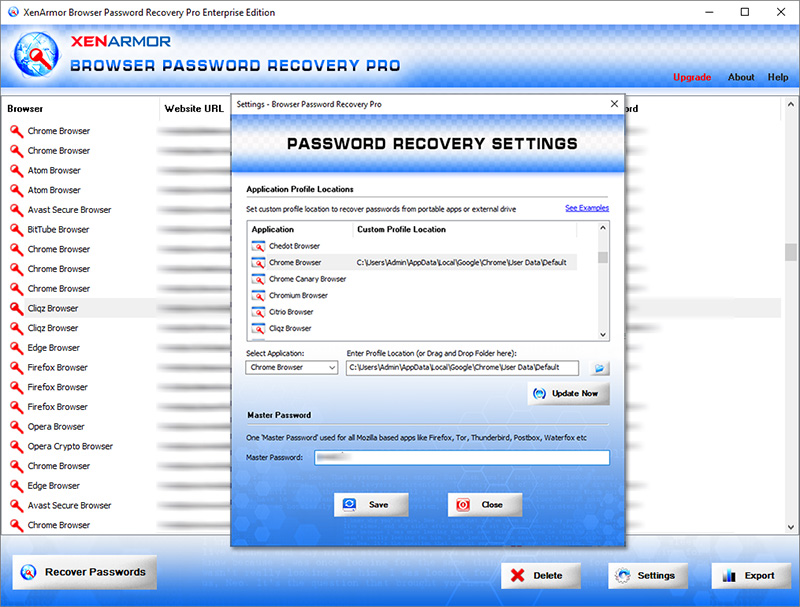
Here are the key features loved by users,
- Works across 140+ web browsers
- Recover all website passwords
- Also recover Form Autofill secrets (key, code, credit card etc)
- Extract from all profiles & custom locations
- Support command-line & automation
- Easily identify with multi-colored display
- Export secrets to PDF, HTML, CSV, JSON & more
👉 Free Download XenArmor Browser Password Recovery Pro
Recommended Posts
How to Switch from PIN to Password Login on Windows
November 29, 2025