

How to Recover Saved Passwords in Opera Browser (Step-by-Step Guide)


In this guide, you will learn where Opera & all its variant browsers saves your passwords, how they are secured using encryption, and the easiest way to recover them instantly.
Opera Browser Password Storage Location
Opera & all the variant browsers store all your website login credentials in a file named “Login Data”, located at:
[Opera]
C:\Users\[user_name]\AppData\Roaming\Opera Software\Opera Stable\Login Data

[Opera Air Browser]
C:\Users\[user_name]\AppData\Roaming\Opera Software\Opera Air Stable\Login Data

[Opera GX Browser]
C:\Users\[user_name]\AppData\Roaming\Opera Software\Opera GX Stable\Login Data

[Opera Crypto Browser]
C:\Users\[user_name]\AppData\Roaming\Opera Software\Opera Crypto Developer\Login Data

[Opera Neon Browser]
C:\Users\[user_name]\AppData\Local\Opera Software\Opera Neon\User Data\Default\Login Data
This file is a SQLite database containing a table called “logins”, where all saved credentials are stored.
Important Fields in “logins” Table
- origin_url => Website Page URL
- signon_realm => Website Domain
- username_value => Username or Email
- password_value => Encrypted Password
How Opera Browser Encrypts Passwords
Opera browser is a Chromium-based browser and follows a similar encryption model used by Chrome, Edge, Brave browser etc.
Older Versions (< v80)
- Passwords were encrypted using Windows DPAPI
- Can be decrypted using system APIs like CryptUnprotectData
Newer Versions (v80 & above)
Passwords are encrypted using a master encryption key stored in the “Local State” file:
C:\Users\[user_name]\AppData\Roaming\Opera Software\Opera Stable\Local State
Encryption Key Details
- Older versions (< v135): encrypted_key
- Newer versions (> v135): app_bound_encrypted_key
The master key is stored in Base64 format and protected using Windows DPAPI along with modern encryption algorithms.
- AES-GCM
- ChaCha20
- AES+CNG (based on browser version)
Multi-Level Process to Decrypt Master Key
- Decode Base64 key
- Decrypt using System DPAPI
- Decrypt again using User DPAPI
- If not 32 bytes, decrypt further using AES-GCM, ChaCha20 or AES+CNG (v140+)
Final master key (32 bytes) is used to decrypt saved passwords using AES-256-GCM algorithm.
Important Note: Since Opera browser uses user-specific and machine-bound encryption, saved passwords cannot be decrypted from another user account or external drive unless advanced recovery methods are used (see solution at the end of this post).
How to Recover Opera Browser Passwords Automatically
Recovering Opera passwords manually can be time-consuming due to multiple encryption layers.
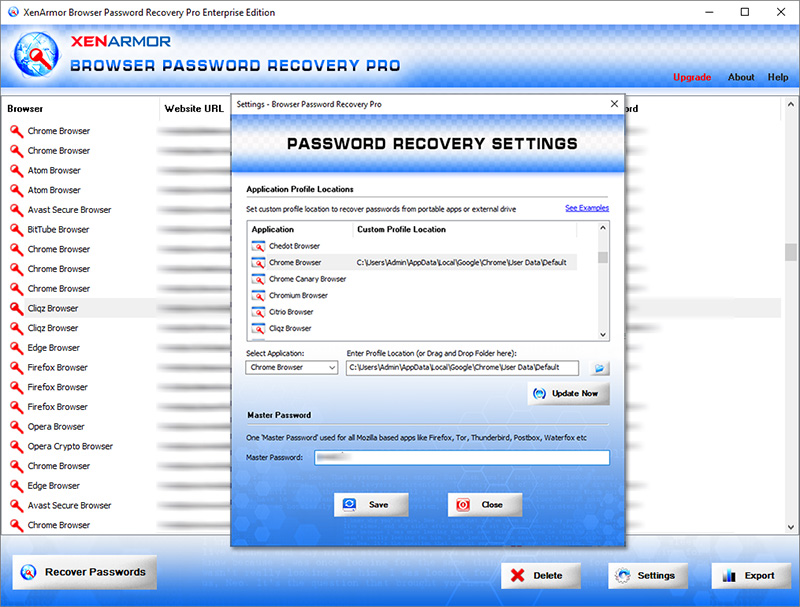
With XenArmor Browser Password Recovery Pro, you can instantly recover all Opera passwords with a single click.
Follow these simple steps:
- Download & install the software from here
- Click on “Recover Passwords”
- View all saved Opera browser passwords instantly
Key Features:
- Recover passwords from 140+ browsers
- Recover all website passwords
- Recover Form Autofill secrets (cards, codes, keys)
- Extract from all profiles & custom locations
- Command-line & automation support
- Export to HTML, PDF, CSV, JSON & more
👉 Free Download Browser Password Recovery Pro
To recover Opera browser passwords from external drives or other user accounts,